
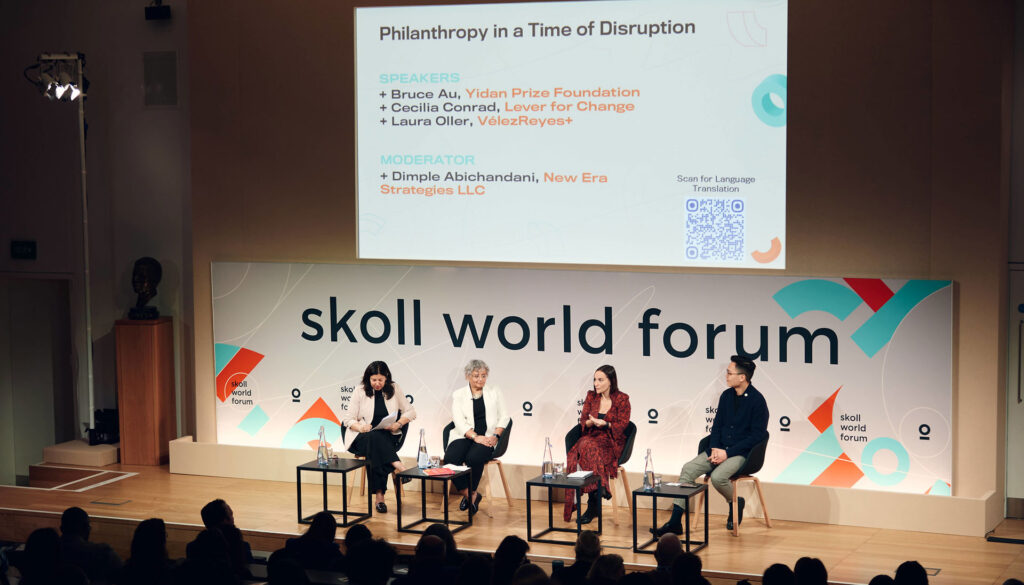
Some thoughts from RPA’s Executive Director, Victoria Tayler:
Skoll week left me feeling energised, challenged, and—perhaps most importantly—hopeful.
That may seem like an odd reaction given the context. This year’s conversations were shaped by a shared and sobering reality: shrinking aid budgets, increasing demand for services, rising operational costs, and mounting pressure on social impact organisations to do more with less. Across the sector, many organisations are being asked to stretch already thin resources further, absorb more uncertainty, and continue delivering in increasingly fragile environments.
None of this is new, but this week I noticed a shift in our collective response.
Across conversations with funders, practitioners, intermediaries, and partners, there was a change of tone. Less certainty. Less performance. More candour. More willingness to interrogate assumptions that have shaped the sector for years but are now proving increasingly difficult to defend.
As someone working to mitigate risk across a conservatively structured sector, this feels like progress.
Partnership has to mean more than proximity
One of the clearest themes to emerge at Skoll was that partnership is being re-examined—not rhetorically, but structurally.
For years, the sector has become increasingly fluent in the language of partnership. But too often, partnership has meant little more than alignment in principle or proximity in process: regular check-ins, collaborative language, shared participation in systems that remain fundamentally unequal.
What I heard this week was a growing appetite for something more honest.
There was increasing recognition that partnership cannot simply mean consultation without influence, or collaboration without shared accountability. If partnership is to be meaningful, it has to involve greater transparency, more balanced decision-making, and a clearer understanding of who holds power, who carries risk, and who gets to shape priorities.
The language of partnership is no longer enough and as funders and implementers call for change, the question that arises is whether our structures are built to support more than what we are currently doing.
Trust is becoming a financing strategy
Some of the most useful conversations I heard and participated in were not about innovation as an abstract concept, but about what resilience actually requires.
And increasingly, that conversation is coming back to trust as a strategy.
Trust, in practical terms, looks like flexible capital. It looks like longer timescales and fewer assumptions that resilience can be built through short-term, tightly restricted funding. It is funding that reflects the real cost of adaptation, organisational learning, and uncertainty.
There appears to be growing recognition that many of the systems we have built to manage risk have, in practice, redistributed it—often onto the organisations least equipped to absorb it.
Trust-based philanthropy is sometimes framed as a values conversation but, increasingly, it feels like a financing one. If resilience is the goal, trust is cannot be peripheral to the strategy, it must be embedded in our funding mechanisms.
Power remains the central question
Across sessions on health systems, pooled funds, philanthropy, and locally led development, one question surfaced repeatedly in different forms: who gets to decide?
Who sets priorities?
Who defines success?
Who carries uncertainty?
Who is trusted to lead?
These are not abstract governance questions. They shape how resources move, how decisions are made, and how risk is distributed across the system.
And they remain largely unresolved.
Much of what the sector continues to describe as inefficiency is, in reality, a function of power: misaligned incentives, asymmetrical accountability, and decision-making structures that still privilege distance over proximity and control over trust.
Power remains the central operational issue in development and philanthropy—not because we lack the language to describe it, but because even though it is acknowledged, we have yet to fully redesign the systems that reproduce it.
The sector is adapting—but unevenly
There was real evidence this week that adaptation is happening.
We heard strong examples of organisations diversifying revenue streams, rethinking operating models, building stronger partnerships, and becoming more intentional about resilience. We saw encouraging examples of funders reconsidering assumptions around overhead, unrestricted support, and the relationship between accountability and control.
These are all significant developments, but the picture is uneven.
For every example of thoughtful adaptation, there were equally clear reminders of where strain is most acute—particularly for locally led organisations navigating shrinking budgets, rising expectations, and increasing pressure to remain both flexible and under-resourced.
The sector is adapting, yes. But not everyone is adapting with the same margin for error. This distinction is important and it should shape how we think about resilience going forward.
Candour feels like progress
One of the most valuable aspects of conversations at Skoll was the candour, I mentioned above.
In place of institutional performance, I witnessed more honesty about what is not working, where incentives remain misaligned, and what parts of the system need to change.
Of course, reflection alone is enough, but honesty is often the necessary precursor to redesign. After all, it is difficult to build more resilient systems while remaining unwilling to name what makes them fragile.
This week felt, in many rooms, like a meaningful move in that direction.
What comes next
I’m leaving Skoll with a stronger sense that the future of this sector will depend less on finding new money, and more on using power, partnership, and risk differently.
That means moving beyond performative collaboration toward genuinely shared accountability. It means treating trust not as generosity, but as infrastructure. It means becoming more honest about how risk is distributed and more deliberate about how it is shared. And it means recognising that resilience is not simply a function of efficiency, but of how relationships, resources, and decision-making are structured.
The challenges ahead remain significant, but so too does the opportunity to respond differently.
And after everything I saw this week, that possibility feels a little more real.